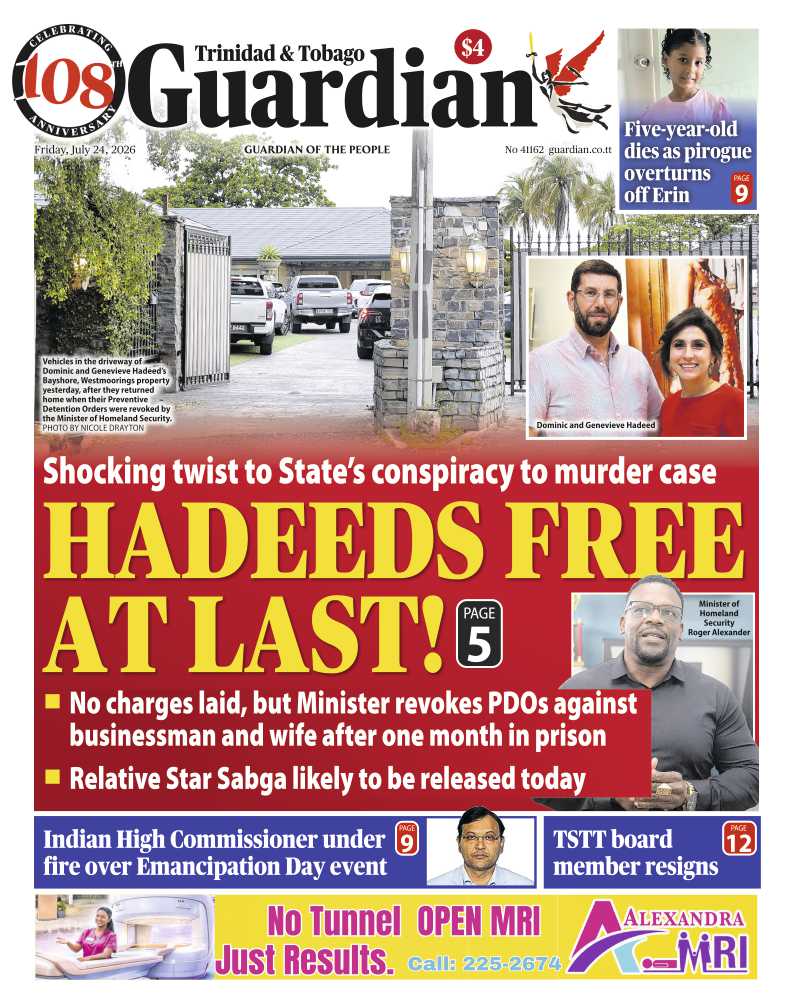
Homeland Security Minister Roger Alexander’s decision yesterday to revoke the Preventive Detention Orders (PDOs) issued against businessman Dominic Hadeed and his wife, Genevieve, may be the most dramatic reversal of a Government decision in Trinidad and Tobago’s nearly 64 years of Independence.
Never before has a government moved from detaining a prominent citizen on the basis of grave allegations to ordering that person’s release while those allegations remain unresolved.
The announcement, made via a news release during a Cabinet meeting, came just one day after attorneys representing the minister challenged the findings of the State of Emergency (SoE) Review Tribunal. The tribunal had concluded that Hadeed’s continued detention was “not necessary or expedient in the public interest” and recommended his release.
The legal challenge was puzzling. Alexander argued that the three-member tribunal did not give him an opportunity to be heard before reaching its decision. Yet, the law does not require the Minister of Homeland Security to accept the tribunal’s recommendations. It was therefore unclear why the Government felt compelled to contest a finding it was under no obligation to follow.
In explaining his decision to release the Hadeeds, Alexander cited a medical report detailing Hadeed’s health conditions and the care required by his specialists. However, Hadeed’s medical challenges were hardly new information.
Just one week earlier, state attorneys persuaded a Court of Appeal panel, led by Chief Justice Ronnie Boodoosingh and including Justices Mark Mohammed and Ricky Rahim, to grant an interim stay of a separate Court of Appeal ruling that had ordered the Hadeeds released to home confinement at their Bayshore residence. Both appellate panels were fully aware of Hadeed’s medical condition and his need for specialist treatment.
The minister himself would also have been aware of those health concerns long before yesterday’s announcement. It is difficult to understand how a medical report could suddenly alter the Government’s position when the same issues had already been before the courts.
Alexander stated that, in carrying out his constitutional responsibilities, he was required to balance the detainees’ right to liberty against the need to protect public safety during the State of Emergency. He concluded that the balance now favoured release.
He also noted that the Hadeeds could otherwise have remained detained until the end of the SoE after the Privy Council declined to hear their matter on an expedited basis.
This abrupt concern for Hadeed’s welfare sits uneasily beside statements made by Attorney General John Jeremie on June 10 that appeared to foreshadow the businessman’s detention.
More importantly, the release raises broader questions about the Government’s use of preventive detention powers. If the State has now concluded that the Hadeeds should be released without charges being laid, what does that mean for the continued detention of others held under PDOs?
The Government has consistently declined to provide detailed reasons for the detentions. Combined with the failure to bring charges against any detainee, that lack of transparency has now weakened public confidence in the process.
Whether justified or not, the Hadeed affair has exposed significant vulnerabilities in the State’s handling of preventive detention powers. Those shortcomings may ultimately become the most enduring legacy of this chapter in the country’s latest State of Emergency.